
For most tuna spreads at 5.5 to 7 knots, run your corners 25–35 feet back, short riggers 75–100 feet, long riggers 150–200 feet, and a shotgun 250–300 feet. Then fine-tune every line so it sits on the face of a wake wave.
Those numbers are a starting point, not a rule. Every boat throws a different wake, and the right distance changes with sea state, speed and what the fish are doing that day. The crews who catch consistently don’t just let out a set number of feet — they read their wake, stagger every line, and keep adjusting until the bites tell them where the fish want it.
This guide walks through how to read your wake, where each position goes, and when to tighten up or stretch out.
Count waves, not just feet
A lure riding on the front face of a wake wave looks alive; the same lure in the trough between waves bogs down, hides, or tumbles. That’s why experienced crews talk in waves (“put the bar on the fourth wave”) more than in feet.
The spacing between your stern waves is set almost entirely by boat speed. The waves your hull makes travel at the same speed as the boat, and in deep water that fixes their length: roughly 0.56 × speed in knots², in feet.
| Trolling speed | Distance between wake waves |
|---|---|
| 5.5 knots | ~17 ft |
| 6 knots | ~20 ft |
| 6.5 knots | ~24 ft |
| 7 knots | ~27 ft |
| 7.5 knots | ~31 ft |
| 8 knots | ~36 ft |
So at 6.5 knots, a short rigger at 75–100 feet lands around the third or fourth wave. Speed up a knot and every wave moves back several feet — which is why a lure that was swimming perfectly can start misbehaving after a throttle change.
How to set a line on a wave: let it out to the starting distance, watch it for 30 seconds, then ease it forward or back a few feet until it rides the front face and pops out of the water only now and then. Mark the line with a rubber band or a dab of paint once you find the spot.
The spread at a glance
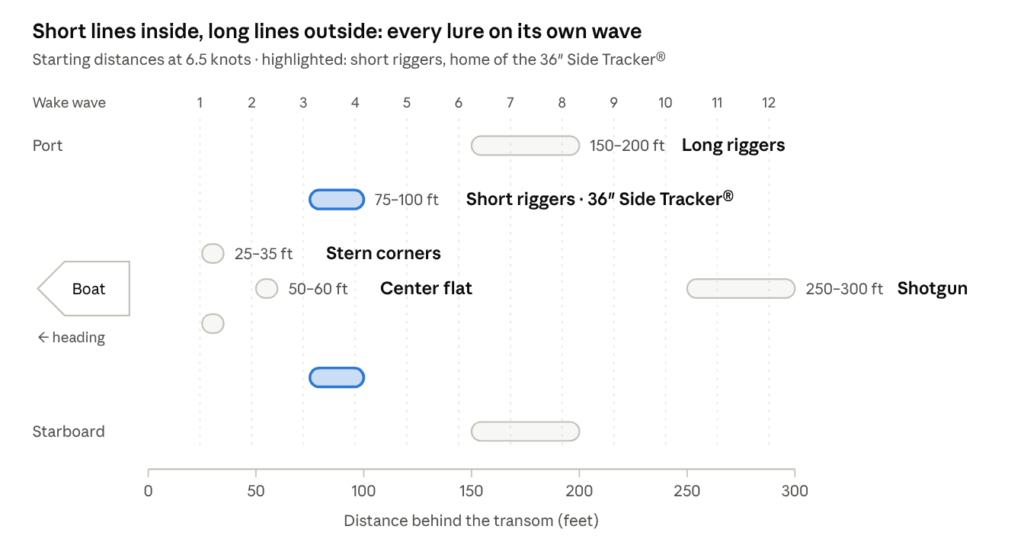
Each bar is a starting range for one position; the dotted lines mark wake waves about 24 feet apart at 6.5 knots, so every line sits on its own wave.
Position by position
Stagger every line so no two lures share the same wave, and keep the shorter lines inside and the longer lines outside so they can’t cross on a turn.
| Position | Distance back | Wave at 6.5 kt | What to run there |
|---|---|---|---|
| Stern corners (flat lines) | 25–35 ft | 1st–2nd | Daisy chains, cedar plugs, diving plugs — the busy water near the transom raises fish |
| Center flat / center rigger | 50–60 ft | 2nd–3rd | A single standout lure, like a Joe Shute with ballyhoo, in the slot between the corners and riggers |
| Short (inside) riggers | 75–100 ft | 3rd–4th | 36″ Side Trackers® and spreader bars — the big “school” profile in clean water just outside the prop wash |
| Long (outside) riggers | 150–200 ft | 6th–8th | 19″ Side Trackers® or smaller bars; they track outward and widen the spread |
| Shotgun | 250–300 ft | 10th–12th | A lone lure way back for line-shy fish; shorten it when other boats are working the same pod |
In our Northeast midshore bluefin spread, that looks like 19″ Side Trackers® on the outside riggers, 36″ Side Trackers® on the inside riggers, a Joe Shute on the center rigger, and a daisy chain and diving plug on the corners.
Where the Side Tracker® fits: it pulls outward on its own, away from the boat and out of the turbulence. That puts the bar in cleaner water than a traditional bar at the same distance, and lets you add lines without tangling. More on how it works.
Spreader bar placement varies by region. Mid-Atlantic and Northeast crews often run bars off the riggers; others run them as the longest flat line, 75–150 feet back, to keep the bar from skipping. Both work — the key is a bar that swims on the surface without hopping out of the water.
When to tighten up or stretch out
Start with the baseline, then let conditions and bites move the lines.
- Rough seas: lures blow out of the water on the crests. Slow down half a knot and shorten the riggers a wave so each lure stays buried; give the shotgun more line so it stays down in the swell.
- Flat calm: fish can see the boat and get line-shy. Stretch the riggers and shotgun back and lean on long lines.
- Speed changes: every knot you add moves each wave back several feet (see the table above). Re-check every line after a speed change.
- Fish showing close behind the boat: tighten the whole spread. Tuna crashing the corners is a sign they want it in the white water.
- Bites only on the long lines: move a short rigger back to the distance that’s getting hit. If one position gets bit twice, copy it.
- Heavy boat traffic on a pod: shorten the shotgun and long riggers so you can turn tight without crossing lines with other boats.
- Different species: bites come differently from species to species and day to day. Keep notes on which positions get hit for each species and lean the spread that way next trip.
When nothing is biting, change one thing at a time — distance, then speed, then lure — so you can tell what made the difference.
Common mistakes
- Two lures on the same wave. They compete for the same fish and tangle on the turn. Stagger every line at least half a wave apart.
- Bars in the prop wash. The white water directly behind the engines tumbles a spreader bar. Move it out to the riggers or back a wave until it swims clean.
- Setting distances once and forgetting them. Speed and sea state change all day; a line that was perfect at 8 a.m. may be in a trough by noon.
- Long lines inside short lines. If a long line runs from an inside position, it will cross the short lines on every turn. Short inside, long outside.
- Letting out line by guesswork. “About a hundred feet” varies by a wave or two between crew members. Mark your lines or count reel passes so every angler sets the same spread.
Build your spread
The lures below cover every position in the spread; prices as of October 14, 2026.
| Position | Lure | Price |
|---|---|---|
| Short (inside) riggers | 36″ Side Tracker® with 9″ Floating Bulb Squid | $189.99 |
| Short riggers, bigger profile | 36″ Wingman Side Tracker® with 9″ Shell Squid | $214.99 |
| Long (outside) riggers | 19″ Side Tracker® with 6″ Floating Bulb Squid | $159.99 |
| Stern corners | Wingman Big Eye Bandit Daisy Chain | $74.99 |
| Stern corners | Carlson Offshore Money Maker Daisy Chain | $69.99 |
Want the whole spread matched and ready to fish? Our Captain Spreads are complete setups built by working captains, or browse everything for tuna.
How far back should you troll for tuna?
Corners 25–35 feet, short riggers 75–100 feet, long riggers 150–200 feet, shotgun 250–300 feet — then adjust each line so it rides the face of a wake wave.
How far back should a spreader bar be?
Typically 75–150 feet, either off the riggers or as a long flat line. It should swim on the surface in clean water, outside the prop wash, without skipping out of the water.
What does “fourth wave” mean in trolling?
It’s the fourth stern wave counted back from the transom. At 6.5 knots the waves are about 24 feet apart, so the fourth wave is roughly 95 feet back.
What speed should you troll for tuna?
About 5.5–7 knots for spreader bars, Side Trackers® and mixed spreads. All-artificial spreads can run up to 8–10 knots, but most bars get unstable above 8.
How many lines should be in a tuna spread?
Five to seven is common: two corners, two or four rigger positions, and a shotgun or center rigger. Run only as many as your crew can clear quickly on a multiple hookup.
How far back should your shotgun be?
Usually 250–300 feet, straight down the middle and well behind everything else. That’s roughly the 10th to 12th wave at 6.5 knots. It’s there for line-shy fish that won’t come up into the spread. Run it from the highest rod holder or the center rigger so it clears the other lines on turns, and shorten it when other boats are working the same pod.
Should you run anything in your prop wash?
Yes, but only the right lures. Fish often come up to the white water behind the transom, so it’s a good spot for daisy chains, teasers, cedar plugs and small diving plugs on the corners. Keep spreader bars and Side Trackers® out of it. The turbulence makes a bar tumble and skip, so set them on the riggers or back a wave or two where the water is clean.